
How to Collect and Store Flower Seeds – Easy Pro Tips
Learn when to harvest flower seeds, how to clean them, and how to store them safely for next season, plus my favorite easy flowers to save from.
How to harvest seeds from flowers in fall. Collecting flower seeds from your garden or your neighborhood is the perfect fall-day activity. It is fun to build your own annual flower collection, and it is one of the cheapest ways I know to get more variety in your garden. Come on, let’s take a peek at how I have done it for years.

How to Harvest Seeds From Flowers (and keep them safe)
How to harvest seeds from flowers in fall. Collecting flower seeds from your garden or your neighborhood is the perfect fall-day activity. It is fun to build your own annual flower collection, and it is one of the cheapest ways I know to get more variety in your garden. Come on, let’s take a peek at how I have done it for years.
How to Harvest Seeds From Flowers (and keep them safe)
Let me show you how I have saved seeds from annual flowers for years. I will explain exactly when the best time to harvest seeds is, how to clean the seeds, and how to store them safely for future use.
I’ll also share my own favorite flowers, the ones that are so easy to save seeds from.
Stick around to the end, because I have added a little FAQ that answers the questions gardeners actually ask Google this time of year. (Short on time? The FAQ at the bottom covers when pods are ready and whether you can save seeds from a store bouquet.)

Why Collecting Seeds is a Great Idea
Well, why indeed? What is there not to love about collecting your own seeds to plant in spring?
I love collecting seeds from flowers because it is fun, easy, and rewarding. Gathering seeds gets me outside, helps me enjoy the beautiful fall weather, and makes me dream of next year’s garden. I can’t walk past a lovely garden with blooms going to seed without taking a handful home with me. I am forever picking seeds out of the lining of my jackets and out of the pockets in my pants.
I like to select and reproduce the prettiest, most successful flowers in my garden. I love having a wide range of different flowers, and growing annual flowers gives me the best opportunity for creating my own picking garden. The fact that this is one of the most frugal ways to create a beautiful garden is a nice bonus.

Other than picking and regrowing flowers from my own garden, I like to collect seeds from other places as well. Most seed-making flowers set seeds abundantly. No gardener objects to you collecting a seed head or two from their hollyhocks or poppies. In fact, many gardeners trade seeds freely and for free.
Since so many flowers set seeds in huge quantities, it is easy to collect far more than you can use next season. So why not collect and save seeds from your favorite flowers, package them up pretty, and give them as gifts to your gardening friends?Or do a little guerilla gardening and turn them into seed balls.
Oh, and by the way. I usually don’t collect all the seeds from my garden flowers. I also allow seeds to fall and scatter haphazardly or to be eaten by the birds. But collecting and saving annual flower seeds makes it easy to re-plant them exactly where I want them next year.
My current garden is still a project in development, but I already have some favorite annual flowers growing. My tried and tested favorites include cosmos, foxgloves, hollyhocks, and dill. This year I was gifted some new annuals I had never heard of before, and especially the ‘Kiss-me-over-the-garden-gate’ is so beautiful and lovely (and that name is so funny!) I can’t wait to save some seeds for next year. Although apparently, it will seed itself quite nicely too.
Tools and Materials for Harvesting Seeds
You don’t need many things for gathering seeds, but a few things are good to keep on hand.
- Paper bags, cups or jars (1 for each kind of flower you are collecting).
- Scissors or garden clippers
- Small (paper) bags (I use these vellum bags), envelopes, boxes or containers to keep the seeds
- Sharpie for labeling the seeds after harvest
- A pair of garden gloves (I think these are hysterical!) (for the more prickly kind of flowers)
A nice big table to work on is nice too. I prefer to do this outside on a non-windy day. You can do it inside but be prepared for a fair bit of cleaning up afterward because handling dried seed and seed pods can get quite messy.

More Storage and Organizing ideas:
How to store essential oil bottles
DIY key organizer
How to organize washi tape
The Best Time for Saving Seeds from Annual Flowers
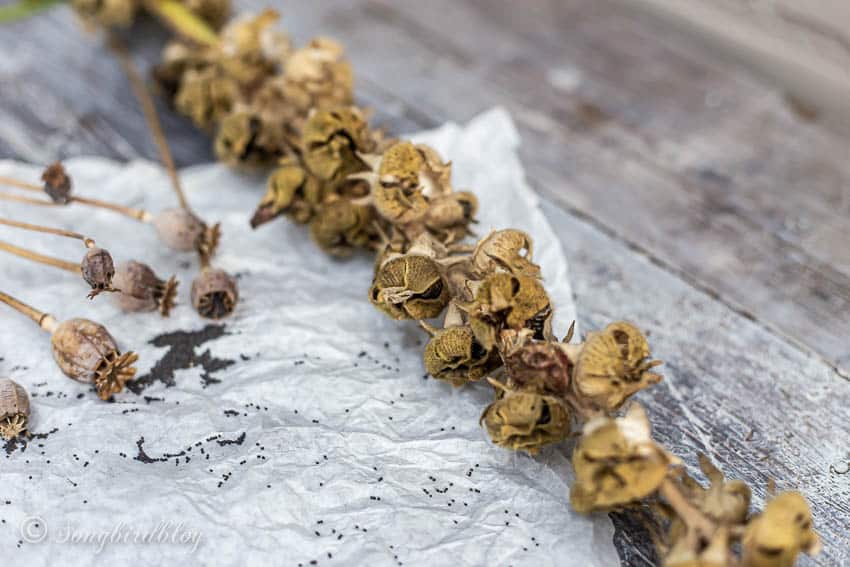
Late summer or early fall is the perfect time to harvest seeds from flowers, because most will be ripe. You will know the seeds are mature when the flowers are dead and the pods or seed heads are dry, brown, and split open easily.
So it is important to be a bit of a ‘lazy’ gardener and let your flowers bloom and wither naturally. If you cut flowers too soon, they will not be able to form seed pods. The seeds need to grow and dry naturally on the plant to be strong and viable for the next season.

Be patient and give your flowers enough time on the plant to dry into full seed pods. The seeds are ripe when you can hear them rattle if you shake the pod, or when the little tufts come loose easily.
Don’t wait too long either, or the flowers will have sown themselves already, or the birds or mice will have eaten the seeds. Poppy seeds are particularly loved by mice.
The best day is a sunny, non-windy day after a dry spell. Try to beat the fall rains, or your seeds will be too wet and hard to dry sufficiently. If the seeds are not quite ready but the weather is about to turn: cut the stems with the seed pods attached and let them dry out fully in a dry space.
If the seeds are not quite ready yet, but the weather is about to get wet and nasty: cut off the stems with the seed pods attached and put them in a dry space to dry out fully.

How to Get Seeds From Flowers And Save for Next Spring
Choose the best and biggest flower heads and seed pods. Use clean pruning shears to snip the dried flower head. Usually it is best to collect the flower heads whole and take them apart on a table or tray. Some flowers fall apart as soon as you touch them. With those, collect the seeds directly at the plant before removing the flower head.
Pick the best-looking, developed seeds to save. The keepers are usually bigger, darker, and firmer than the underdeveloped ones.
If you suspect even a little moisture in the flower heads, dry them spread out on newspaper or inside a brown paper bag for a week or two. A clean pizza box works great too.
Don’t forget to keep your seeds separate and mark them so you can remember which is which.
Can You Get Seeds From Cut Flowers or a Store Bouquet?
This is the question I get asked most, and I want to be honest with you. In most cases, no. Fresh cut flowers generally have not set seed, and a cut flower will not continue to make seeds. Once the stem is cut, the flower stops maturing, so a fresh bouquet from the store usually has nothing to harvest.
There are two exceptions worth knowing. If you let a cut flower dry out completely with its head intact, some varieties will finish ripening an already-formed seed head. And if the bouquet flowers were already going to seed when they were cut, you may find a few seeds. But don’t count on it. If you want to save seeds, the reliable way is to let flowers mature and dry on the plant in the garden.
How to Clean Seeds Before Storing
If you plan to gift or swap your seeds, it is nice if your collection is clean and free of dried plant bits. For your own use, this step is not really necessary. It won’t hurt if you plant the seeds next season along with a bit of plant material.
If you skip the cleaning, it is very important that the plant bits are completely dry. Even the tiniest bit of moisture could bring bacteria, fungus, or mold into your seeds.

There are several ways to clean seeds. Handpick any larger pieces of leftover plant bits out of the collection. Gently blow over the seeds while swirling them, so the lighter chaff blows away. Or drop them from a few feet high and let the wind carry the dry, light bits away. That last one works best for bigger, heavier seeds.
How to Store Flower Seeds Safely For Next Season
Seeds should be stored cool and dry, where they can fully rest. Make sure they are safe from pests and rodents. Mice and birds love seeds.
The absolute best place to store dried flower seeds is in airtight containers in the fridge or freezer. That way their lifespan is almost indefinite. If you plan to use your seeds next year, a spot inside the house is fine too.

I like to use small paper coin envelopes for storing my seeds. They are easy to store, you can write directly on them, and they look nice. In the past, I have also collected matchboxes for seed storage or hand-folded little bags.
I like to use small paper coin envelopes for storing my seeds. They are easy to store, you can write directly on them, and they look nice. In the past I have also collected matchboxes for seed storage, or hand-folded little bags. Plastic baggies or containers work too. Just make sure everything is bone dry, because plastic traps moisture.
If you have a large collection and plan to save flower seeds every year, it might be worth investing in proper seed storage. (I am in love with this feed storage container set, just wow!).

Store your flower seeds somewhere dry, temperate, and safe. It is best if the seeds remain in the dark to prevent them from germinating prematurely.
The Best Flowers for Seed-Saving
Over the years I have successfully grown dozens of different flowers from seeds I collected in my own garden. Some are easier than others. When you harvest seeds from flowers, the process is exactly the same for annual and biennial flowers. The difference comes next spring, when you plant them.
Annual flowers: marigolds, dill, sunflowers, love-in-a-mist (Nigella), sweet peas, nasturtium, cosmos, zinnia, poppies, and bachelor’s buttons (cornflower).
Biennial flowers: foxgloves, hollyhocks, pansies, forget-me-nots, and honesty (money plant, Lunaria).
Fun Facts About Seeds
The largest seeds in the world are the seeds from the tree ‘Coco du Mer’, which once produced a seed of 25 kg (55 lbs). The smallest seeds in the world are grown by orchids in the rainforest: one seed weighs just 1/35,000,000th of an ounce (0.81 micrograms). The longest known distance a floating seed has traveled is 15,000 miles. The oldest seed that was still viable and grew into a plant was 30,000 years old.
FAQ: Harvesting Seeds From Flowers
How do you get seeds out of a flower?
Wait until the flower head is completely dry and brown on the plant, then snip it off and crumble or shake the seed head over a tray. For pods, shake them and listen for the rattle. The seeds fall out or rub loose between your thumb and fingers.
Can you pick seed pods before they dry?
Not really, and this is where patience pays. Seeds need to mature and dry on the plant to be viable. If bad weather is coming and pods are almost ready, you can cut the stems with pods attached and finish drying them indoors in a warm, dry spot. But pods picked green usually won’t ripen into good seeds.
How do you dry out flowers to get seeds?
Spread the cut flower heads or pods in a single layer on newspaper or a screen, or pop them in a brown paper bag, and leave them somewhere warm and dry with air moving for a week or two. Shake the bag now and then. Once the seeds come loose easily and sound dry, they are ready to clean and store.
Is it illegal to replant your own seeds?
For most garden flowers, no. Saving and replanting your own seeds is a tradition as old as gardening itself. The exceptions are certain patented or trademarked hybrid varieties, where the seller’s contract or patent restricts saving seeds. Heirlooms and ordinary garden annuals like the ones on my list above are always safe to save and replant.
I sincerely hope I have inspired you to start collecting seeds and creating a beautiful flower garden for free. Next time you see a garden full of ‘ugly’ brown flowers, think about all the seeds growing there and applaud that gardener for giving the flowers a chance to renew and regrow. Be that gardener!
Do you save seeds from your garden? Which flowers are your favorites to collect? Tell me in the comments, I would love to know.

Want to remember this? Save this harvesting flower seeds tutorial to your favorite Pinterest board!

My Dad was a seed saver. He was one to use his junk mail envelopes to put his seeds in and label. Since my weather is usually mild, I try to shake the dried pods and I get reseeding this way. I have good success for several years with two late blooming cosmos (they bloom in orange and yellow in late August to first freeze around mid November or Dec). They look like fall then as the weather changes! Another flower is a type of salvia that has broader leaves and the flowers are coral white tubes. I just shook a long seed pod this morning. My button zinnias also reseed when I make sure to let some go to seed. I’m having to buy less annuals now! I should be more organized but sometimes I just bury the plant seeds in the pot–like my Potulaca–and up it came as my reseeded Dahlsberg Daisy, also reseeded itself, came up as the other was nearing its end. So maybe I’m a seed saver yet of a different variety?!!’
Oooh, you got such nice pictures of the seedheads! I’ve tried to photograph mine a few times and they never come out right 🙂
Question: are there any tricks to making sure the seeds germinate when you plant them the next year? Last year I saved zinnia, basil, cilantro, and dill and the only ones that came up reliably were the dill seeds. A few zinnias came up, but only one cilantro and no basil. Just curious if some varieties of plants did better than others? My cilantro reseeds itself in the garden just fine, but planting the coriander seed sure didn’t work 🙂
My father gave me a bunch of lazy susan flowers this fall. I’m drying the seeds but what not? What am I doing?
email me please
Love
Erin